Inklaim Guides Patent drawings
Guide · The basics
Patent drawings are the sheets attached to a patent application: A4 pages with black line figures, numbered “FIG. 1, FIG. 2”, and reference numerals that point to the description. They make the invention understandable and follow the form rules of each office: EPO, PCT, USPTO and, in Italy, UIBM.
Updated October 2026 · Sources: OJ EPO 2025, A49, Rule 11 PCT, 37 CFR 1.84, Art. 22 D.M. 33/2010
The right words
All the sheets of an application together. It is the legal term: the EPO lists request, description, claims, drawings and abstract as separate documents (Art. 2(3), OJ EPO 2025, A49), as does Art. 22 of Italy’s D.M. 33/2010.
The individual A4 pages, numbered. Each sheet has a usable area bounded by the margins and can hold several figures.
The individual views: FIG. 1, FIG. 2, and FIG. 1A, FIG. 1B for partial views. They carry the reference numerals (reference signs).
In short: a patent application contains drawings; the drawings are made of A4 sheets; each sheet holds one or more figures. The same reference numeral identifies the same part in every figure, in the description and in the claims.
Types of figures
The figures must show what is needed to understand the invention. In the United States, 37 CFR 1.83(a) requires the drawing to show every feature specified in the claims.
Orthographic views (front, side, top) and an axonometric view of the same object, often on the same sheet and at the same scale.
A section line marks the plane (A-A; at the EPO also XXII-XXII, Guidelines A-IX, 7.3.1). Hatching must not cover the reference numerals.
Separated parts show how the assembly fits together; enlarged details isolate a small area. In the US, an exploded view is enclosed in a bracket.
For methods and software: numbered steps S100, S102… The EPO and the PCT treat them as drawings (Art. 1(3), EPO Decision 2025; Rule 7.1 PCT).
For systems and circuits. In the US, conventional elements may be shown as labeled boxes (37 CFR 1.83(a)).
An exception only: the EPO accepts them when the subject cannot be drawn (Guidelines A-IX, 1.2); the USPTO generally does not (1.84(b)).
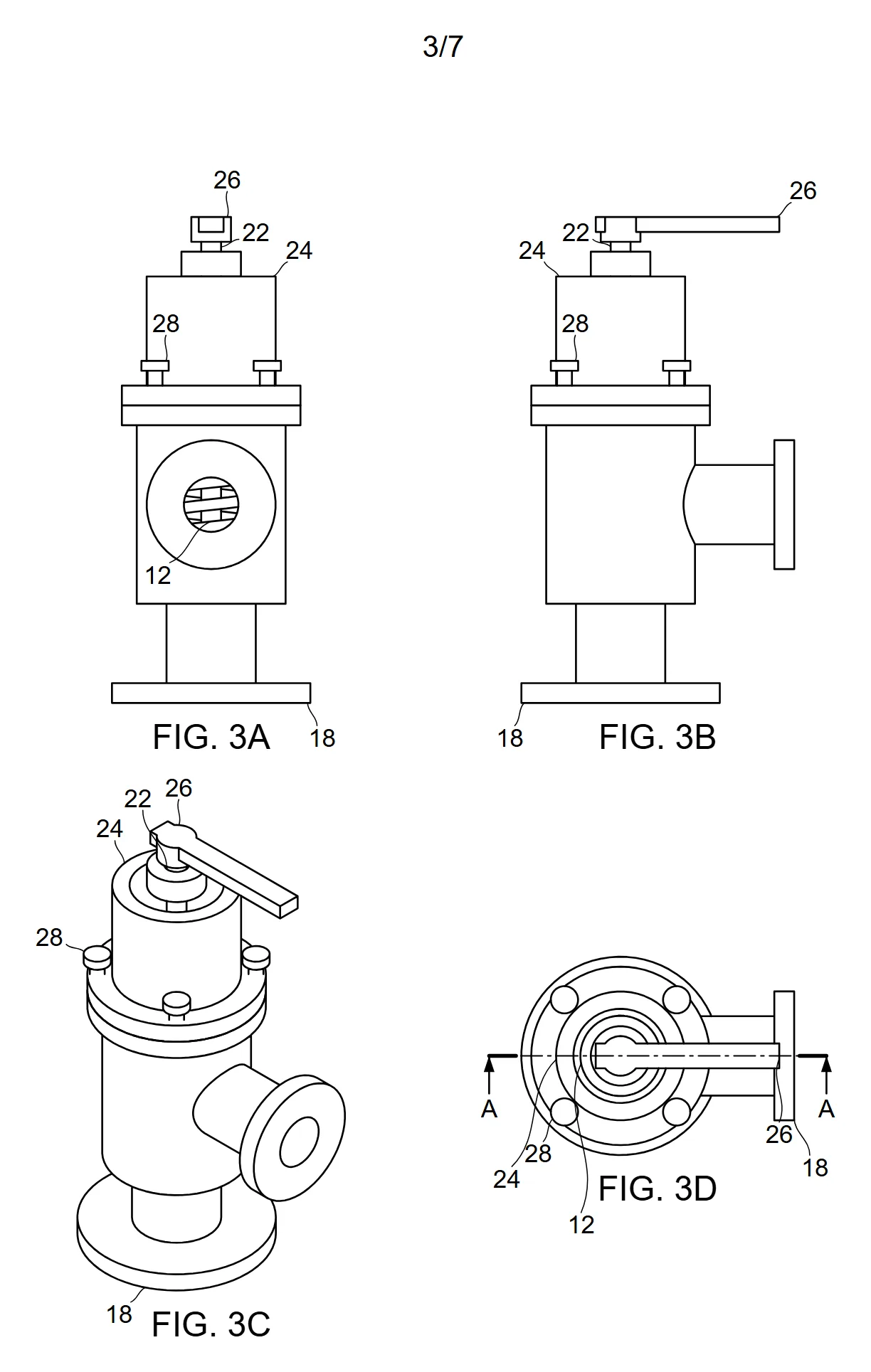
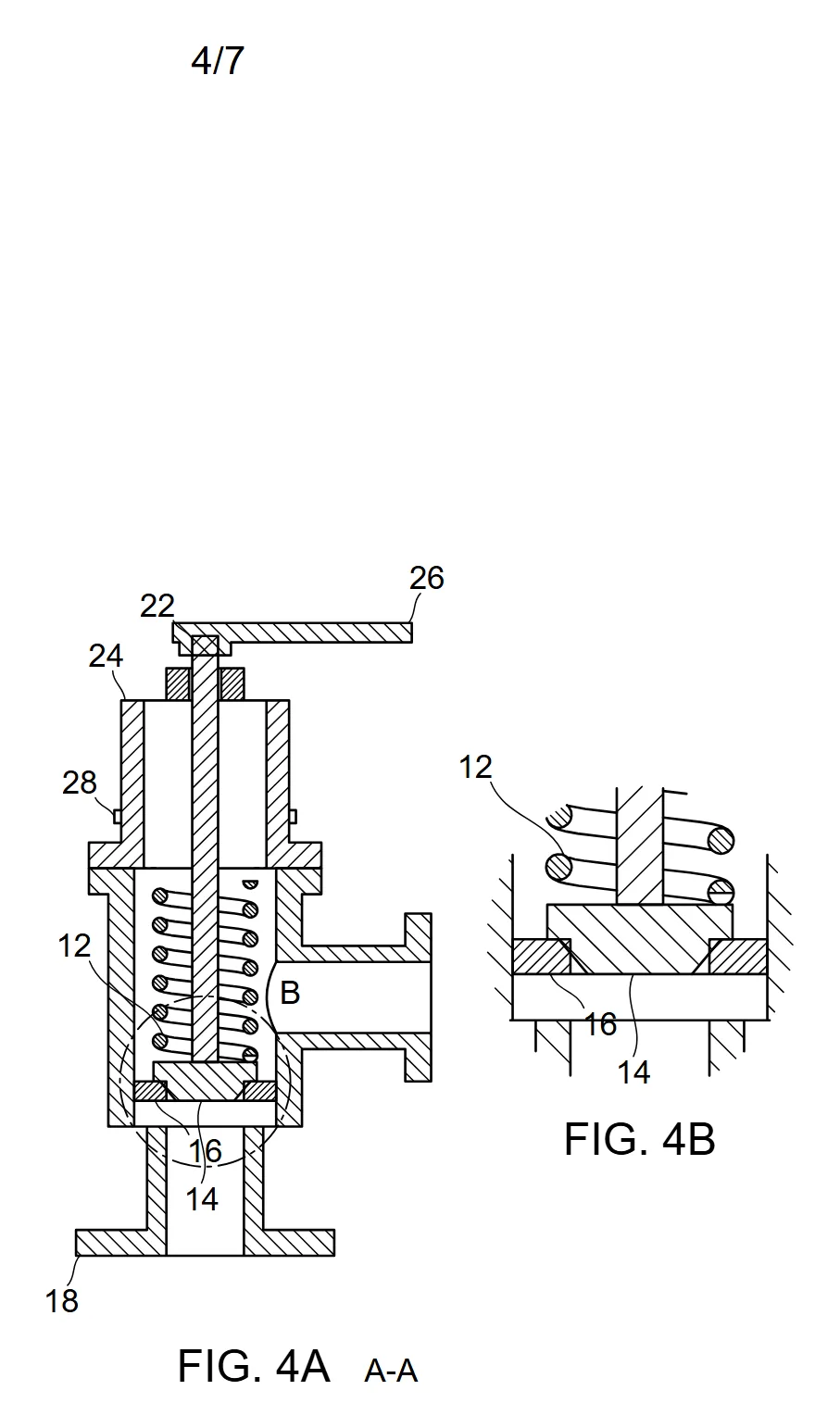
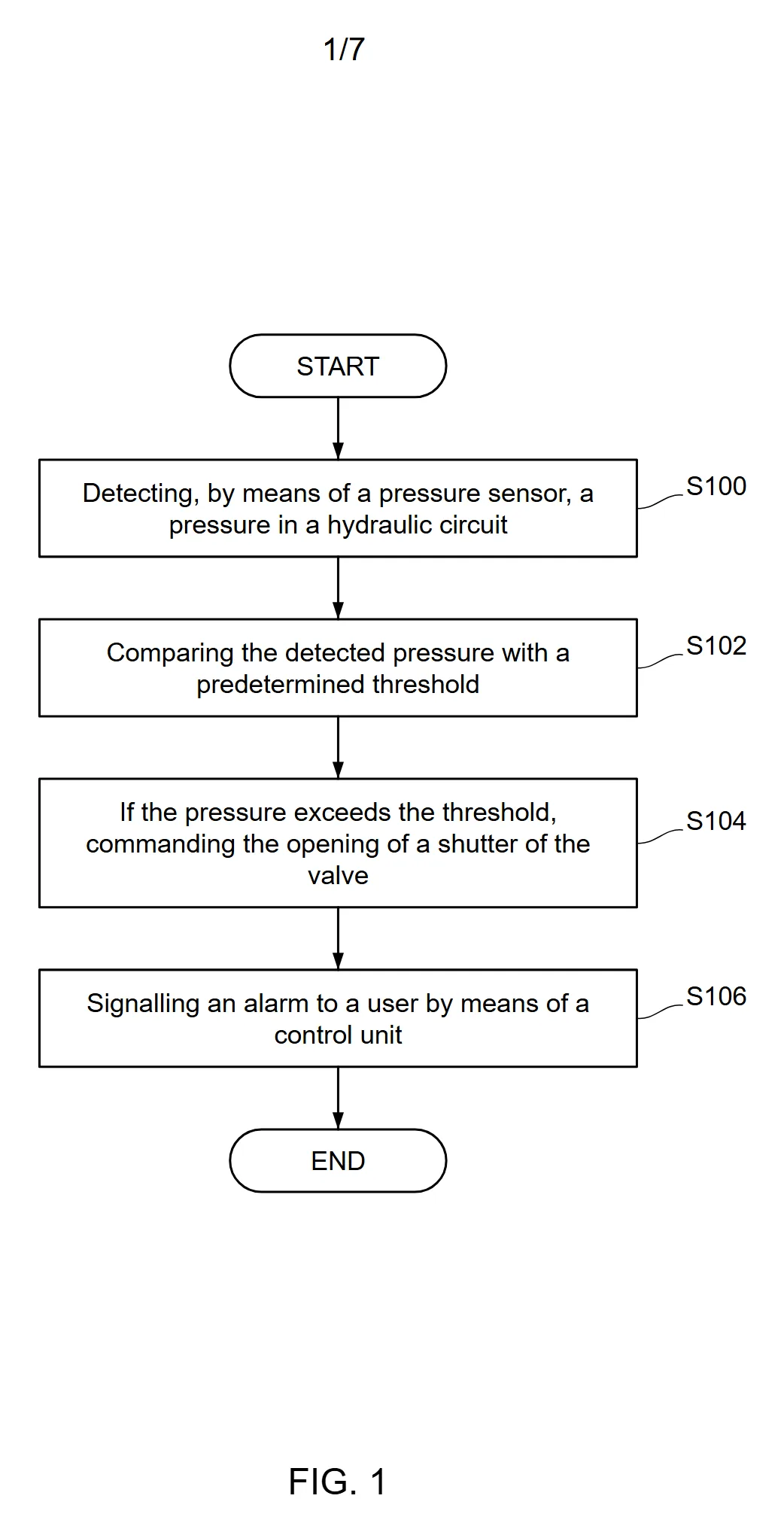
Sheets exported from Inklaim with sample data.
Form rules
The rules are similar, but they are not the same. Knowing the differences saves you from redoing a sheet when the application moves from one office to another.
| Rule | EPO | PCT | USPTO | UIBM (Italy) |
|---|---|---|---|---|
| Sheet | A4 | A4 | A4 or US Letter | A4 |
| Margins (top / left / right / bottom) | 2.5 / 2.5 / 1.5 / 1 cm | 2.5 / 2.5 / 1.5 / 1 cm | 2.5 / 2.5 / 1.5 / 1 cm | at least 2.5 cm on all sides |
| Height of numbers and letters | ≥ 0.32 cm | ≥ 0.32 cm | ≥ 0.32 cm (1/8") | not specified (0.32 cm as good practice) |
| Sheet numbers | Arabic numerals, centered at the top | “1/3, 2/3, 3/3” | “1/3”, centered at the top | consecutive |
| Figure labels | “FIG” | Arabic numerals | “FIG.” | consecutive numbering |
| Color | electronic filing only, since 1 Oct 2025 | published in black and white | only by petition | no, black lines |
| Text in drawings | indispensable words only | “a few short catchwords” | minimal legends | only what is needed for understanding, plus the scale (chamber of commerce practice) |
| Source | OJ EPO 2025, A49 | Rule 11 PCT | 37 CFR 1.84 | Art. 22 D.M. 33/2010; Genoa Chamber of Commerce guide (secondary source, for text; in Italian) |
The UIBM asks for 2.5 cm on all sides: a sheet laid out for the EPO does not meet it to the letter. Since 1 January 2023, PDFs filed on the UIBM portal must be PDF/A (UIBM circular 621).
The EPO accepts color and grayscale since 1 October 2025, but only online (OJ EPO 2025, A57). The International Bureau publishes PCT applications in black and white; the UIBM wants black lines.
PCT and USPTO number the sheets “1/3”; the EPO uses consecutive Arabic numerals. The EPO writes “FIG”, the USPTO “FIG.” (37 CFR 1.84(u)).
The article-by-article detail is in the guide to EPO patent drawing requirements and in the guide to Italian patent drawings (UIBM).
The workflow
In an IP firm, the draftsperson prepares the sheets and the patent attorney checks them against the text and approves them. These are the steps.
How Inklaim helps
Inklaim is web software from an Italian start-up founded in Turin that prepares draft patent drawings, checked against EPO, UIBM, USPTO, PCT, CNIPA and KIPO rules, from 3D CAD models (STEP/IGES), DXF or vector PDF files, photos of an object, sketches and claims.
The geometry always comes from your files: AI is optional and does not draw. The final check and the filing stay with your firm. Learn more about patent drawing sheets from 3D models, simplifying patent figures, the reference numeral check and automatic figure numbering, or see all features.
FAQ
It depends on the office. The EPO requires black, uniformly thick and well-defined lines, generally drawn with drafting instruments (Art. 1(2)(a) and (e) of the Decision of 7 July 2025). For an Italian application, Art. 22 of D.M. 33/2010 also accepts drawings made by hand.
Generally not. The EPO accepts them only when what must be shown cannot be drawn (Guidelines A-IX, 1.2); the USPTO only when they are the only practicable medium (37 CFR 1.84(b)).
Not always. The EPO accepts 1.5 cm on the right and 1 cm at the bottom, while the UIBM asks for at least 2.5 cm on all sides. A sheet with 2.5 cm margins everywhere meets the minimums of both.
At least 0.32 cm (1/8 inch) for the EPO, PCT and USPTO. The Italian regulation sets no value for drawings; 0.32 cm is normally used there too.
The pilot
Over 4 weeks, 3 to 6 people from your firm redo 3 matters that have already been filed and published, using Inklaim, and compare time and quality with your usual work.