Inklaim Guides Reference signs

Guide · Reference signs

Reference signs in patent drawings: the rules

Reference signs, also called reference numerals, link the parts shown in the figures to the text of a patent application. The EPO, PCT and USPTO rules agree: the same part always has the same sign, and no sign appears in the drawings unless it is also in the text, and vice versa. All three also require plain signs, without brackets or circles.

Watch out for amendments. If you delete a figure, the EPO Guidelines for Examination A-IX, 7.5.4 ask you to delete from the description and claims all reference signs relating solely to that figure. If you delete a passage of the description, a part that is no longer described there should not keep its sign in the drawings.

Updated October 2026 · For patent attorneys and patent draftspersons

1 = 1
one part, one sign, in every figure and throughout the text
↔
every sign in the drawings is in the text, and every sign in the text is in the drawings
0.32 cm
minimum height of numbers and letters for the EPO, PCT and USPTO (1/8 inch)
( ) ○
no brackets and no circles around signs in the drawings
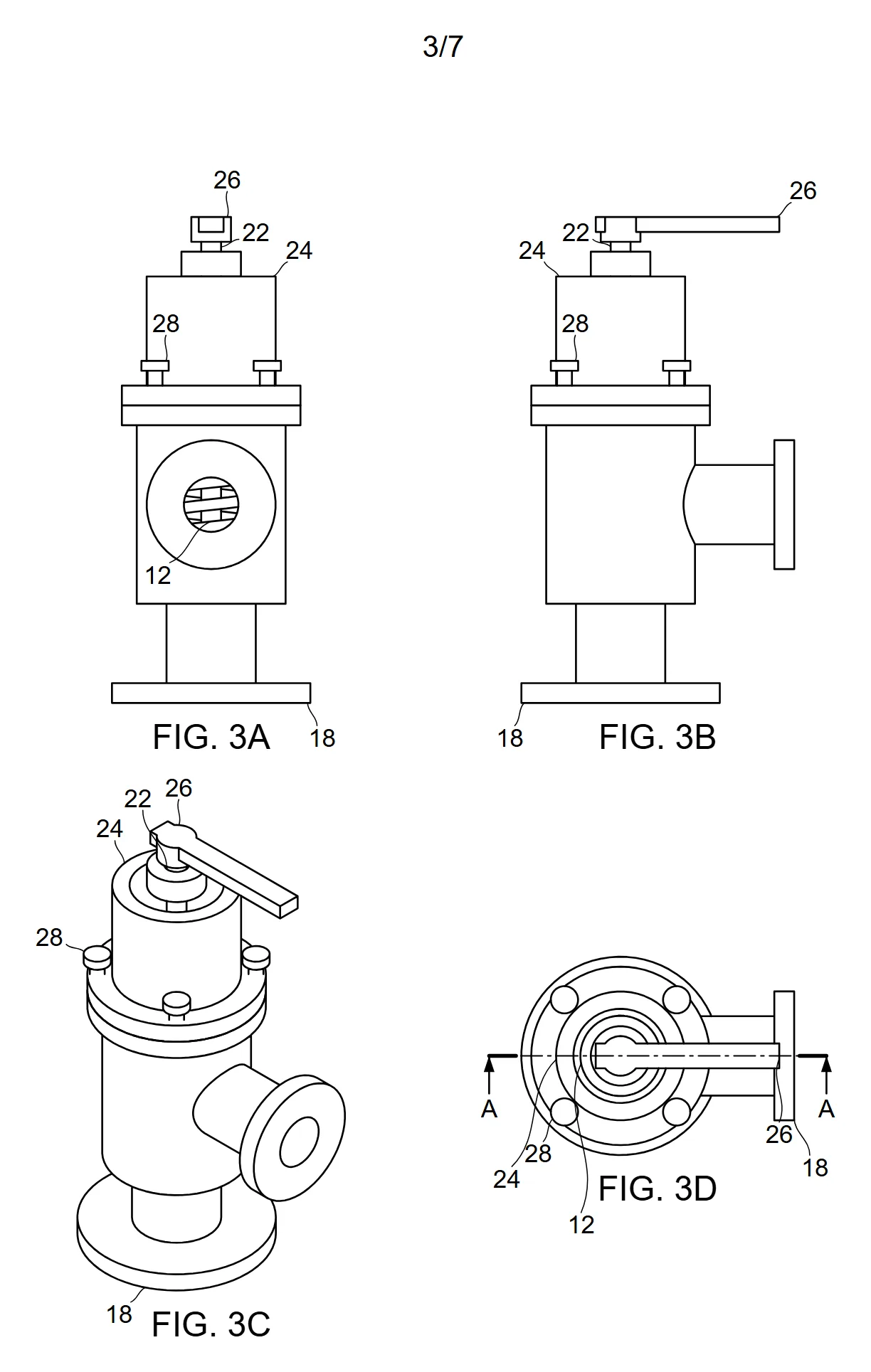
Patent drawing sheet 3/7 with FIG. 3A, 3B, 3C and 3D of a valve: reference numerals 18, 24, 26 and 28 designate the same parts in every view
On sheet 3/7 of the sample matter, reference signs 18, 24, 26 and 28 designate the same parts in all four views.

What are reference signs?

They are the numbers, and sometimes letters, that designate a part of the invention in the figures and that the description refers to: “the lever 26 rotates about the stem 22”. The official EPO texts call them reference signs; the US rules call them reference characters and prefer numerals to letters (37 CFR 1.84(p)(1)). In day-to-day practice most attorneys simply say reference numerals.

Use the Latin alphabet, and the Greek alphabet only where it is customary, for angles or wavelengths (EPO Guidelines A-IX, 7.5.3, Rule 11.13(h) PCT, 37 CFR 1.84(p)(2)).

Reference signs are where the drawings and the text meet. That is why every amendment to the figures, the description or the claims puts them back on the table.

The rules

The six rules for reference signs

Each rule with its EPO, PCT and USPTO provision. The EPO reference text is the Decision of the President of the EPO dated 7 July 2025 (OJ EPO 2025, A49), in force since 1 October 2025, together with the Guidelines for Examination A-IX, 7.5.

01

Plain signs

No brackets, inverted commas, circles or outlines around the sign. Primes such as 6′ and 35″ are not inverted commas and are allowed. The PCT rules prohibit brackets, circles and inverted commas in the same way, and the US rules also prohibit encircled characters.

Art. 1(2)(d) OJ EPO 2025, A49 · Guidelines A-IX, 7.5 · Rule 11.13(e) PCT · 37 CFR 1.84(p)(1)

02

Same part, same sign

A part has the same sign in every figure and throughout the application. A sign never designates two different parts. For variants of an invention, the EPO accepts signs that combine the figure and the feature number, such as 115 in Fig. 1 and 215 in Fig. 2 for common feature 15, if the description says so.

Art. 1(2)(i) A49 · Guidelines A-IX, 7.5.5 · Rule 11.13(m) PCT · 37 CFR 1.84(p)(4)

03

Text and drawings match

A sign that does not appear in the description and claims may not appear in the drawings, and vice versa. The PCT and US rules compare the drawings with the description. For the UIBM, the numbers of the parts must be referred to in the description.

A-IX, 7.5.4 · Rule 11.13(l) PCT · 37 CFR 1.84(p)(5) · Art. 22(3) D.M. 33/2010

04

Legible on the figure

Numbers and letters at least 0.32 cm (1/8 inch) high. The hatching of a section must not impede the reading of signs and leading lines. For the USPTO, signs should not be placed on hatched or shaded surfaces; where needed, underline the character and leave a blank space in the hatching.

Art. 1(2)(b) and (g) A49 · Rule 11.13(b) and (h) PCT · 37 CFR 1.84(p)(3)

05

Short leading lines

They start in the immediate proximity of the sign, extend to the feature indicated, are as short as possible and are drawn like the other lines of the drawing. For the USPTO, where they are called lead lines, they must not cross each other.

Guidelines A-IX, 7.5.1 · 37 CFR 1.84(q)

+

Many signs? A list

With many signs, the PCT strongly recommends a separate sheet listing all reference signs and the features they denote. For complex applications with many drawings, the EPO accepts a reference key at the end of the description.

Rule 11.13(n) PCT · Guidelines A-IX, 7.5.4

The same rules, office by office

RuleEPOPCTUSPTOUIBM
No brackets or circlesArt. 1(2)(d) A49; A-IX, 7.5R. 11.13(e)1.84(p)(1)Not explicit in Art. 22
Same part, same signArt. 1(2)(i) A49; A-IX, 7.5.5R. 11.13(m)1.84(p)(4)Not explicit in Art. 22
Text and drawings matchArt. 1(2)(i) A49; A-IX, 7.5.4R. 11.13(l)1.84(p)(5)Art. 22(3): numbers referred to in the description
Minimum height0.32 cm, Art. 1(2)(g)0.32 cm, R. 11.13(h)0.32 cm (1/8 in.), 1.84(p)(3)Not set for drawings
Leading linesA-IX, 7.5.1—1.84(q)—
List of signsReference key accepted in complex applicationsStrongly recommended with many signs, R. 11.13(n)——

“—”: the provisions cited in this guide do not address the point. For the UIBM, when in doubt, EPO practice is usually followed: check with your Italian patent attorney.
Claims

Reference signs in claims: brackets or not?

Not in the drawings. In the claims of a European patent application, however, the signs are written in parentheses after the feature, if they make the claim easier to understand.

Rule 43(7) EPC provides that, where the application contains drawings with reference signs, the technical features in the claims should preferably be followed by those signs in parentheses, if this increases the intelligibility of the claim. These signs are not to be construed as limiting the claim.

For an Italian application, Art. 21(4) of D.M. 33/2010 allows references to the figures in the claims only for greater clarity, and the reference numerals do not limit the scope of the claim.

One sign, three ways to write it

In the drawings: 26, without brackets or a circle.

In the description: “the lever 26”.

In EPO claims: “a lever (26)”.

Before filing

Which errors should a check catch before filing?

Each one breaks one of the rules above. Almost all of them come from an amendment made in one place and not carried over to the others.

  • A sign cited in the description that appears in no figure.
  • A sign in the figures that the text never mentions.
  • The same numeral for two different parts in different figures.
  • The same part with two different numerals.
  • Signs left in the text after deleting the figure that showed them.
  • A numeral in brackets or circled in the drawing.
  • A numeral covered by hatching or smaller than 0.32 cm.

How Inklaim helps

Reference signs checked across the whole matter, not figure by figure

Inklaim keeps a list of reference numerals shared between the text and the figures. Sheets generated from the 3D model use the numerals already in the application text.

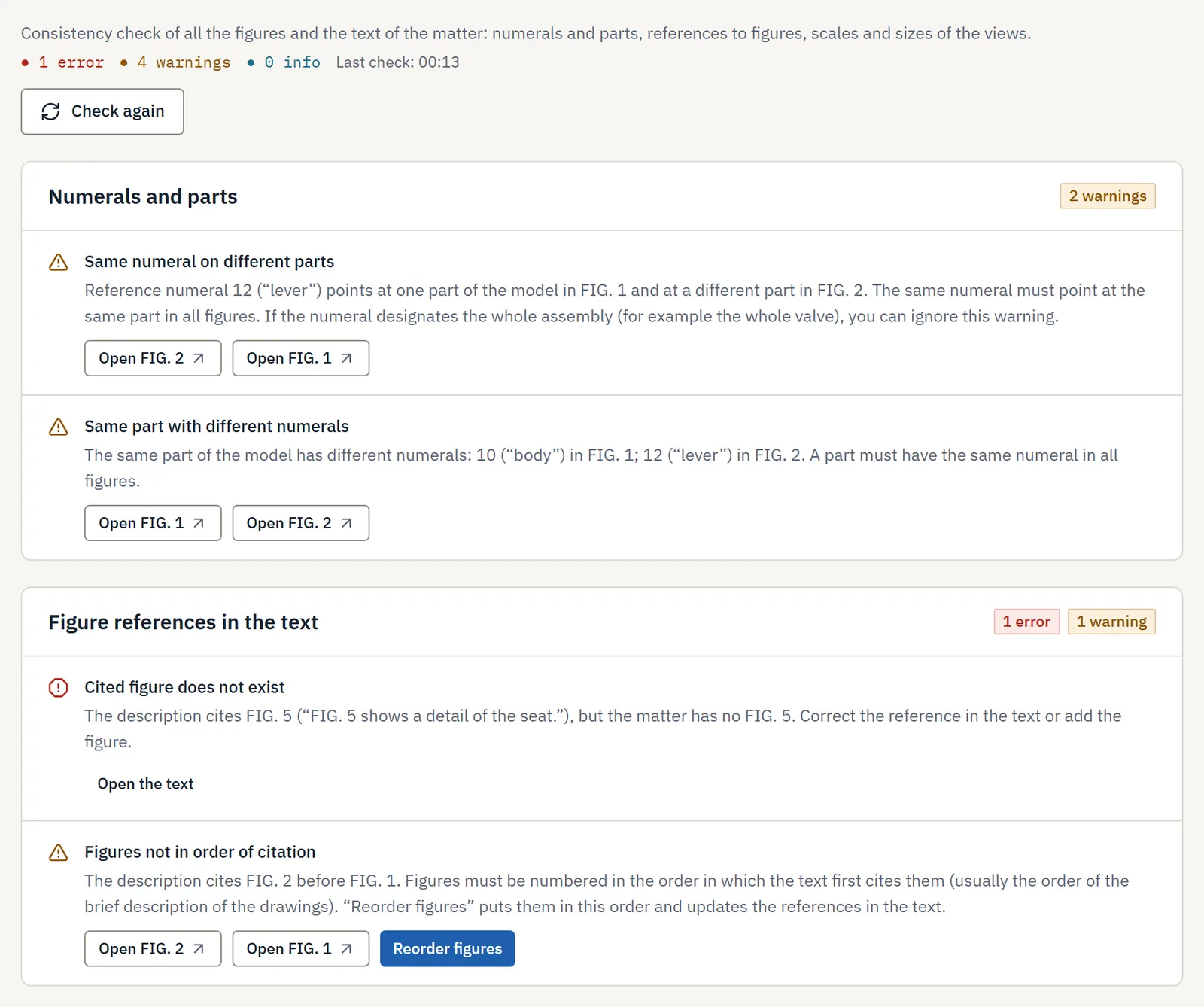
  • The reference numeral consistency check flags the same numeral on different parts, the same part with two numerals, numerals found only in the text or only in the figures, and visible parts without a numeral.
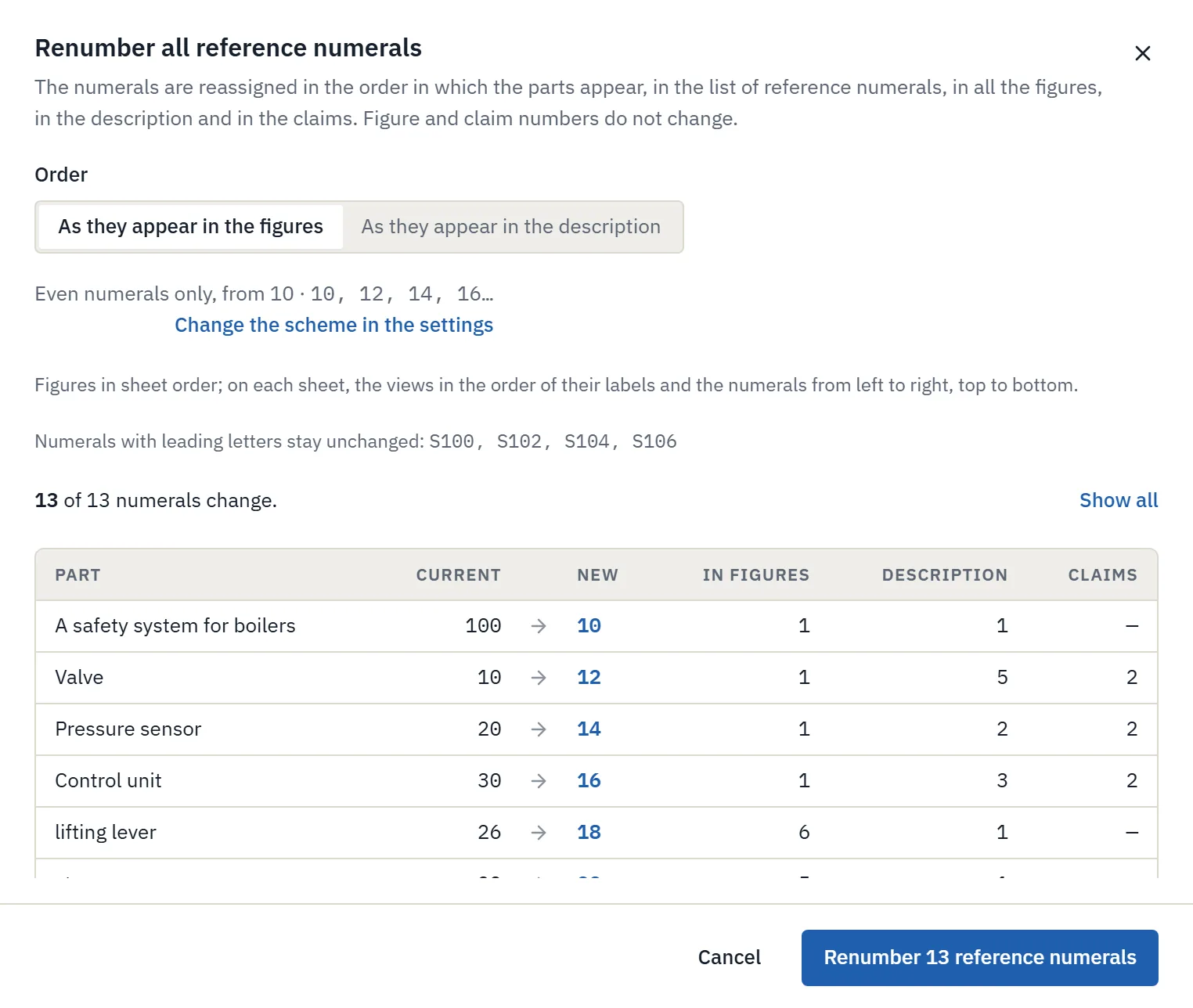
  • “Renumber all” reassigns the numerals in order of appearance, with your firm's scheme: 10, 12, 14…, even numbers only, or hundreds per figure. Details in automatic figure numbering.
  • The “Compliance” panel checks the minimum character height against the EPO, UIBM, PCT or USPTO profile.

The check proposes, you decide. It does not replace the patent attorney's review and does not guarantee acceptance by the office.

Inklaim “Checks” tab with warnings on reference numerals and parts and on FIG. references in the description: 1 error and 4 warnings
The “Checks” tab on a sample matter: each warning opens the figure to fix.
Inklaim “Renumber all reference numerals” dialog with the current and new numeral of each part and its occurrences in the figures, description and claims
“Renumber all”: for each part, the current numeral, the new one and how many times it appears in the figures, description and claims.

FAQ

Questions about reference signs

What are reference signs in a patent?

They are the numbers or letters that designate the parts of the invention in the figures and that the description refers to. They are also called reference numerals; the US rules call them reference characters.

Can reference numerals be put in brackets in patent drawings?

No: the EPO, PCT and USPTO rules prohibit brackets, inverted commas and circles around signs in the drawings. In European claims, however, the signs go in parentheses (Rule 43(7) EPC).

What if a numeral appears in the text but not in the figures?

It must be corrected: EPO Guidelines A-IX, 7.5.4, Rule 11.13(l) PCT and 37 CFR 1.84(p)(5) require the text and the drawings to contain the same signs. It is best found before filing.

If I delete a figure, what do I need to correct in the text?

Delete from the description and claims all signs relating solely to that figure, as EPO Guidelines A-IX, 7.5.4 ask, and update the FIG. references.

Can the same numeral designate different parts?

No. The same part always has the same sign, and a sign never designates two different parts (EPO Guidelines A-IX, 7.5.5, Rule 11.13(m) PCT, 37 CFR 1.84(p)(4)).

Do I need a list of reference signs?

It is not mandatory. With many signs, the PCT strongly recommends a separate sheet listing them (Rule 11.13(n)); the EPO accepts a reference key at the end of the description in complex applications.

The pilot

Test the check on three matters already published

In 4 weeks, 3 to 6 people from your firm use Inklaim to redo the sheets of 3 applications already filed and published. Then we compare time and quality together. It starts after a non-disclosure agreement is signed.

English Deutsch Español Français 日本語 한국어 中文